Submit an original design to the Main Library or the Children’s Branch Bookdrops by Friday, August 31st at 5:00 p.m.
Entries will be displayed in an online poll for community voting during the entire month of September. Winning entries will be printed and distributed at both libraries.
Register at ofpl.online for a copy of The Library Book by Susan Orlean now through August 7th.
The story chronicles the Los Angeles Public Library fire and its aftermath. Get ready for some great conversations and tons of fun as we meet virtually for the first time ever!
Zoom discussions will be held Thursday, August, 20th at 6:00 p.m. and Saturday, August 29th at 2:00 p.m.
Email bmartin@gallupnm.gov or call 505-863-1291 for more information.
Imagine Your Story this summer at OFPL! Adults and Teens can participate in Summer Reading by completing a Book Bingo card available on our website octaviafellin.libguides.com/srp2020.
Win by completing a horizontal, vertical or diagonal line! Turn in your card and you’ll be entered into a weekly prize drawing – OR – complete all 25 squares (Blackout) for an even better prize!
Drop off your card inside our OFPL Book Drop or post a photo of your completed card to one of the Library’s social media channels using the hashtag, #OFPLBookBingo2020, Facebook, Instagram, & Twitter, @galluplibrary.
Entries must be received by 6:00 p.m. on Tuesday, September 1st, 2020. Email bmartin@gallupnm.gov or call 505-863-1291 for more information.
Creative Corner features creativity freedom to make your own art from various materials that can be found around your homes and/or are inexpensive to purchase. Art courses are for the inner creative geared towards individuals 15 years of age and older.
Tune in this upcoming Monday, June 27th at 4:00 p.m. for a demonstration on abstract painting while learning the basics in oil painting. This is Part One in a multi-series exploring the fundamentals in abstract painting. Part One explores techniques and brand names trusted by our resident artist and will be laying the foundation to our painting. Available through our Facebook page and YouTube channel, search @galluplibrary.
OFPL does not own the rights to the music contained within this video.
10 Oil Painting Tips for Beginners
Artists have been painting with oil paints for hundreds of years and oil paints continue to be popular worldwide due to their versatility, quality, and color. While getting started with oil painting is fairly easy, there is a little bit more to it than acrylics, since you are working with toxic solvents and mediums and the drying time is much longer. Individual artists who have been painting for a while have their own favorite brands, brushes, palettes, and mediums, but here are some general tips that may be useful to you if you are just starting out with oil paints.
Learn how to discover new job opportunities using Google Search and organize your job search experience using G Suite tools. In this workshop we also share strategies to improve your resume, tips to help you communicate effectively online, virtual interview best practices, and the latest resources from Google and other partners to help support job seekers.
Creative Corner features creativity freedom to make your own art from various materials that can be found around your homes and/or are inexpensive to purchase. Art courses are for the inner creative geared towards individuals 15 years of age and older.
Tune in this upcoming Monday, June 20th at 4:00 p.m. for a meditative experience using acrylic paints set to calming meditative music. Available through our Facebook page and YouTube channel, search @galluplibrary.
OFPL does not own the rights to the music contained within video.
Drip Painting Definition
The technique of abstract painting exemplified chiefly in the later works of Jackson Pollack and marked by the intricately executed dripping and pouring of the paint on a canvas placed on the floor.
Artist Spotlight
OFPL does not own the rights to any of the following imagery. Courtesy of other artists. (See accreditation).
Jackson Pollock
Full Fathom Five. Oil on canvas with nails, tacks, buttons, key, coins, cigarettes, matches, etc. 50 7/8 inches by 30 1/8 inches. Circa 1947.
In March, the U. S. Congress passed, and the President signed, the CARES Act, legislation designed to provide economic help for Americans affected by the COVID-19 pandemic. As part of the law, most households would receive an “Economic Impact Payment” (a “stimulus check”) of $1,200 per adult and $500 per child under 17 years old, or up to $3,400 for a family of four.
It’s now July — have you gotten your payment yet?
Please take a moment to share your experience with us so that we can better serve the needs of the community.
Creative Corner features creativity freedom to make their own art from various materials that can be found around their homes and/or are inexpensive to purchase. Art courses are for the inner creative geared towards individuals 15 years of age and older.
Tune in this upcoming Monday, June 13th at 4:00 p.m. for a demonstration on collaging with paper materials that can be found around your home. Use old magazines, photographs, books, glue, markers, paint, and more. Available through our Facebook page and YouTube channel, search @galluplibrary.
OFPL does not own the rights to the music contained within video.
Collage Definition
Collage is a technique of art creation, primarily used in the visual arts, but in music too, by which art results from an assemblage of different forms, thus creating a new whole.
5 Contemporary Collage Artists Adding New Layers
Laslo Antal’s Collage – Visual Diaries
Lance Letscher’s Collage – The Pull Towards Collage
Raquel van Haver’s Collage – The Collage Mindset
Vanessa German’s Collage – From Found Objects Towards Assemblage
Creative Corner features creativity freedom to make their own art from various materials that can be found around their homes and/or are inexpensive to purchase. Art courses are for the inner creative geared towards individuals 15 years of age and older.
Tune in this upcoming Monday, June 6th at 4:00 p.m. for a demonstration on the color wheel and a discussion of Color Theory and terminology. Available through our Facebook page and YouTube channel, search @galluplibrary.
Color theory encompasses a multitude of definitions, concepts and design applications – enough to fill several encyclopedias. Color theories create a logical structure for color. For example, if we have an assortment of fruits and vegetables, we can organize them by color and place them on a circle that shows the colors in relation to each other.
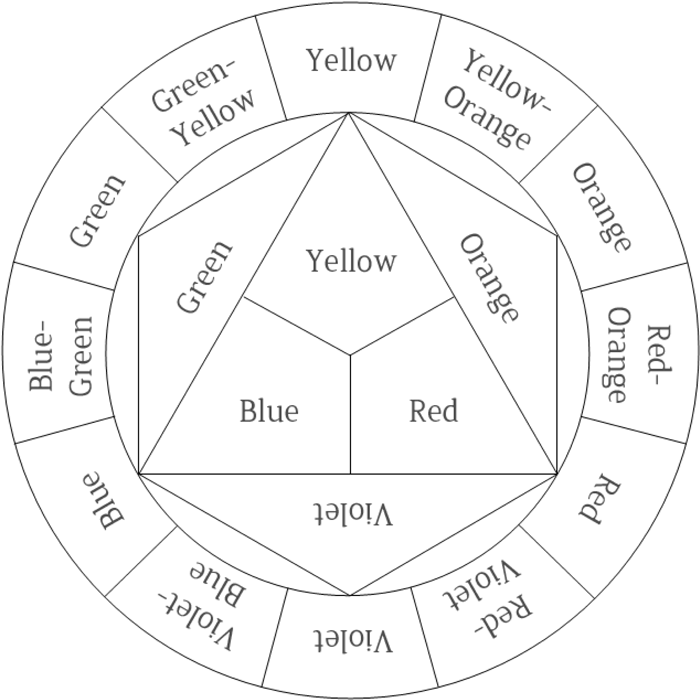
Color Wheel
The Color Wheel A favorite of designers and artists, the wheel makes color relationships easy to see by dividing the spectrum into 12 basic hues: three primary colors, three secondaries, and six tertiaries.
Basic Color Wheel.
Terminology for Review:
Analogous Colors
Any three colors which are side by side on a 12-part color wheel, such as yellow-green, yellow, and yellow-orange. Usually one of the three colors predominates.
Complimentary Colors
Complementary colors are any two colors which are directly opposite each other, such as red and green and red-purple and yellow-green.
Hue
An attribute of a color which makes it unique. Example: Red, Forest Green, Cerulean, Violet, Pink, Magenta, etc.
Primary Colors
In traditional color theory (used in paint and pigments), primary colors are the 3 pigment colors that cannot be mixed or formed by any combination of other colors. All other colors are derived from these 3 hues.
Example: Red, Blue, and Yellow
Secondary Colors
These are the colors formed by mixing the primary colors.
Example: Green, Orange, and Purple
Shade
Refers to the mixture of a hue with black or any darker color. This mixture reduces the overall color brightness.
Tertiary Colors
These are the colors formed by mixing a primary and a secondary color.
A tint is created when you add white to a hue and lighten it. It is also sometimes called a pastel color.
Tone
In art, the term “tone” describes the quality of color. It has to do with whether a color is perceived as warm or cold, bright or dull, light or dark, and pure or “dirty.” The tone of a piece of art can have a variety of effects, from setting the mood to adding emphasis.